top of page

Stone Carving Walked Into the World of Luxury Doors and Never Left

A Mark That Outlasted Everything Else


The earliest known works of representational art were not painted - they were carved. Stone absorbed the first human impulse to make something permanent. Petroglyphs, scratched into rock surfaces using harder stones or antler tools, appeared across prehistoric societies from the Sahara to Scandinavia, Siberia to Australia, not as decoration, but as record. 


The Venus figurines of Upper Palaeolithic Europe, carved from steatite, limestone, and calcite, are among the first known sculptures, some dating back over 38,000 years. 


Long before steel existed, ancient craftspeople worked with abrasion, rubbing stone against stone, filing with carborundum-filled bronze the way the ancient Greeks did, because the desire to shape hard material into something meaningful was insistent enough to find a way. 


When iron finally arrived, and steel chisels became possible, stone carving did not become easier. It became architecture. The same discipline that had been working rock faces since the Palaeolithic now shaped temples, thresholds, and the gates through which entire civilisations passed. 


A luxury home entrance that carries the intelligence of a carved surface does not invoke nostalgia. It is continuing the oldest design logic in human history.


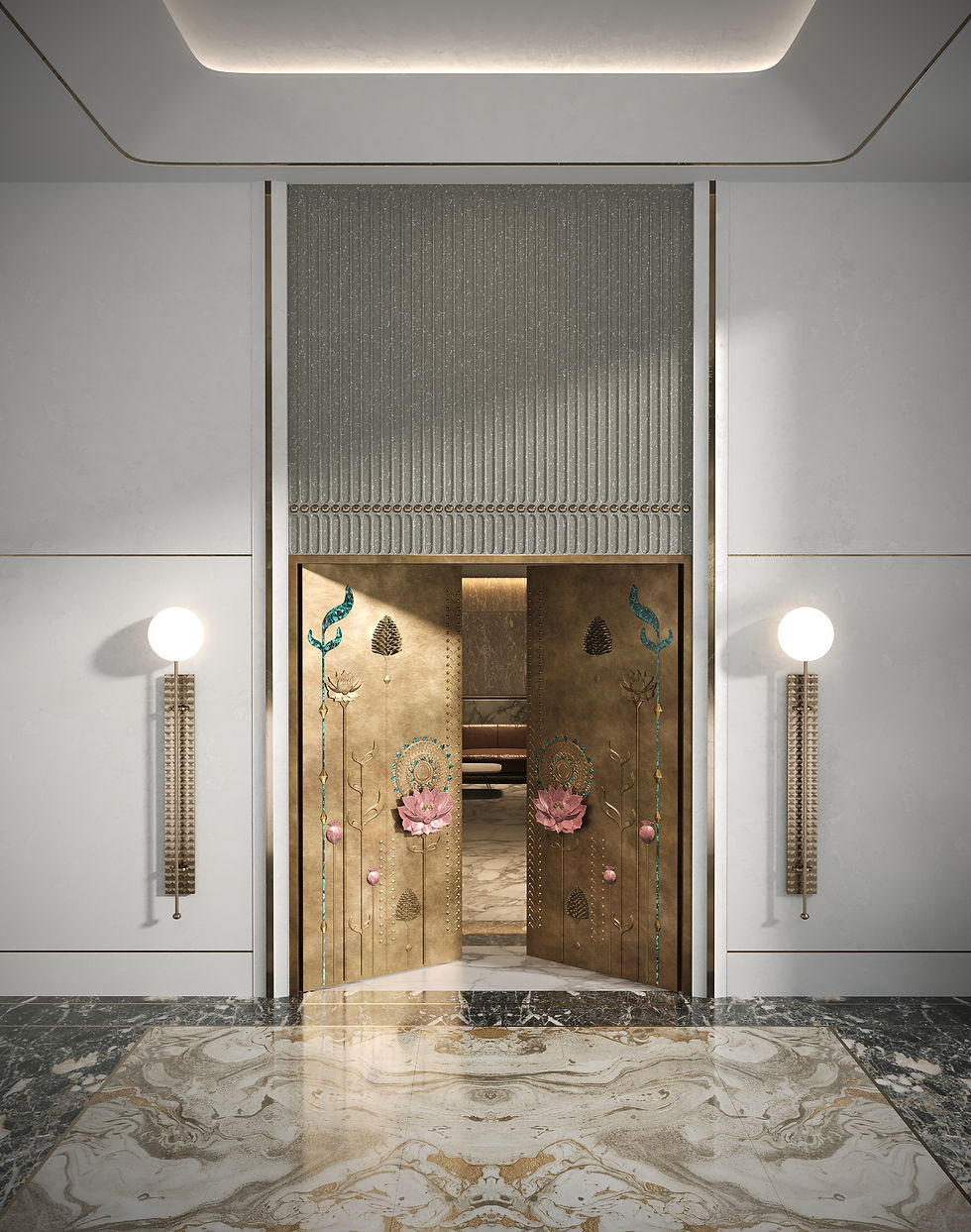
  • The Whispering Blossoms Door

The Whispering Blossoms Door: Gilded spring in iridescent detail.


Carving's Place in the Modern Luxury Home Entrance


The tools evolved: water jet cutting, diamond saws, laser thermal techniques on an industrial scale - but the principle beneath them did not. Depth, relief, and the play of shadow across a worked surface remain as decisive in modern entrance door design as they were in the rock sanctuaries of the ancient world.


  • The Bloom Doorway

The Bloom Doorway: Brass bouquet at dawn's threshold.


What contemporary upscale homes and hospitality spaces have recognised is that machined perfection has a ceiling. A surface untouched by hand, however precise, reads as finished. A surface worked by hand reads as considered. The finest architectural door design has always understood this distinction.


  • The Crystal Descent Door

The Crystal Descent Door: Nature's current, cast in metal.


Stone carving's dimensional logic - the way carved relief catches raking light, the way a recessed line draws the eye into a surface rather than across it - is now applied across luxury home décor metals. The carved threshold did not disappear. It translated.


  • Luxury Metal Door

What Luxury Doors Owe to the Worked Surface


Aluminr's metalwork begins where that translation continues. The discipline that once moved from antler tool to steel chisel to diamond saw now lives in the hand-detailing, embossing, and erosion techniques applied to brass, bronze, and copper across every bespoke front door. 


  • The Echoes of Heaven Door

The Echoes of Heaven Door: Stars mapped onto burnished brass.


A main door finished with deep oxidation and dimensional embossed relief carries the same visual intelligence as a carved stone lintel; depth that changes with the light, texture that rewards proximity, surface that cannot be mistaken for anything produced at volume. 


Luxury metal doors built on this logic do not compete with their setting. They anchor it.


  • The Iris of the Wild

The Iris of the Wild: Grandeur cast in hand-worked metal.


The luxury home décor metals Aluminr works with are not dressed up; they are worked down, layer by layer, until the surface holds the kind of meaning that stone carvers understood from the very beginning: that luxury home entrances are not simply finished - they are made.


WE ARE BESPOKE LUXURY DOOR MANUFACTURERS


  • Luxury Front Door
  • Luxury Front Door
  • Luxury Front Door
  • Luxury Front Door
  • Luxury Front Door
  • Luxury Front Door

THE CHISEL FOUND ITS WAY TO YOUR DOOR


The worked surface has always been the mark of intention - discover what that looks like on your threshold.

Comments


bottom of page